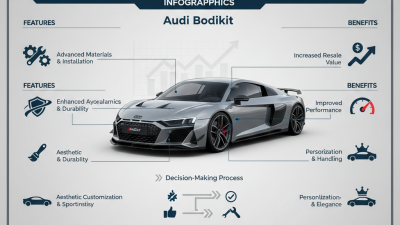
Global buyers are searching for more than aggressive styling when choosing an Audi Bodykit supplier. They need dependable fitment, consistent materials, documented production, and responsive after-sales support. According to Grand View Research, the global automotive aftermarket was valued at approximately US$448.2 billion in 2023 and is expected to grow steadily through 2030. This expansion creates opportunity, but it also increases supplier noise. A large catalog does not automatically prove engineering competence.
The SEMA 2024 Market Report estimated the United States specialty-equipment market at about US$52.3 billion in 2023. That figure reflects strong demand for customization, including exterior upgrades, aerodynamic components, and appearance-focused modifications. Meanwhile, S&P Global Mobility reported that the average age of vehicles in the United States reached roughly 12.6 years in 2024. Older vehicles often require more careful compatibility checks, especially when body panels, sensors, lighting, and mounting points differ across Audi generations. Small errors become expensive quickly.
This guide examines top Audi Bodykit suppliers for international purchasing teams and distributors. It compares manufacturing experience, mold quality, fiberglass or polyurethane options, carbon-fiber claims, inspection procedures, packaging, lead times, and warranty practices. It also considers whether suppliers can provide clear installation drawings and sample approvals. Real purchasing experience suggests that communication often matters as much as price. Not every supplier will excel in every category. That is worth admitting. Buyers should verify test reports, inspect surface finish under strong light, and request vehicle-specific fitment evidence before placing large orders. Reliability is built through evidence, not polished promises.
In international vehicle-part sourcing, HS 8708.10 generally covers bumpers and their parts. A complete bodykit may include front bumpers, rear bumpers, mounting brackets, grilles, splitters, and reinforcement pieces. However, not every component belongs under this code. Classification can depend on design, material, and intended use. Buyers should confirm details with a licensed customs adviser before shipment.
Reliable suppliers provide technical drawings, material specifications, packing photos, and clear production records. Practical checks matter. Ask for bumper dimensions, mounting-point locations, surface finish, and compatibility with the original vehicle structure. Plastic, fiberglass, and composite parts can behave differently during fitting. A small gap near a headlamp may reveal poor tooling or transport damage. Some suppliers offer sample inspections, but production quality can still vary. That limitation deserves attention.
Tips for global buyers: Request a commercial invoice, packing list, and accurate product description. Compare the declared HS code with local customs guidance. Check whether brackets and reinforcement parts require separate classification. Confirm carton strength, moisture protection, and labeling before dispatch. Do not rely only on polished photographs. A physical sample often reveals uneven edges, thin material, or weak mounting points. Perfect fitment is not guaranteed, even with matching model details. Allow room for adjustment, and record every specification in writing.
The 2023 delivery figure of 1.92 million vehicles creates a substantial baseline for the global bodykit market. It suggests a broad customer pool, but deliveries alone do not guarantee equal demand for exterior upgrades. Buyer preferences vary by region, climate, road quality, and vehicle generation.
Experienced importers should evaluate suppliers beyond catalog size. A reliable supplier should provide precise fitment data, clear material specifications, and consistent mold quality. Check bumper alignment, parking sensor compatibility, grille clearance, and installation points before placing large orders. Small errors become expensive when dozens of kits require rework.
Ask for production samples.
A serious supplier can explain whether each kit uses reinforced polymer, fiberglass, or carbon-based materials. Documentation should include packaging dimensions, surface preparation guidance, and replacement policies. These details support safer installation and reduce avoidable disputes. However, the 1.92 million figure is only a starting point. It may include many body styles and markets with limited customization interest. Regional sales data would improve purchasing decisions, but it is not always easy to obtain. I have found that visual appeal attracts inquiries, while accurate fitment converts them. That assumption still needs testing for every market.
For global buyers sourcing Audi-compatible body kits, certification evidence matters more than a polished catalogue. ISO’s 2022 Survey recorded over 1.2 million ISO 9001 certificates worldwide, so a certificate alone proves little. Buyers should verify the certificate number, issuing body, site address, scope, and expiry date through the official certification database. The scope should cover design, moulding, finishing, or automotive component production, not only office administration. Ask for the latest audit report and corrective-action records. Real evidence leaves fingerprints: batch codes, inspection photos, gauge calibration logs, and signed material reports.
IATF 16949 evidence requires closer automotive discipline. The IATF Oversight Division reported more than 77,000 valid certificates in its 2023 public data, showing broad adoption across the supply chain. However, a supplier may hold certification for one factory while quoting from another. Check the exact production site. Review control plans, failure-mode analysis, traceability tests, and process-capability results for plastic panels, grilles, or carbon-fibre parts. A serious supplier can explain how a warped panel was contained, measured, and prevented from returning. That conversation is more useful than a badge.
Do not ignore small gaps. Some suppliers present expired scans or incomplete scopes, often without intent to mislead. Still, buyers must record the risk, request confirmation, and set an approval deadline. Certification is a starting filter, not proof of perfect fit, finish, or delivery performance. (Sources: ISO Survey 2022; IATF Oversight Division public certification data, 2023.)
Global buyers often judge Audi bodykit suppliers by design, price, and shipping speed. Compliance deserves equal attention. A kit that looks clean can still create legal problems after installation.
UNECE Regulation No. 26 addresses external projections on passenger vehicles. Sharp edges, exposed brackets, and poorly finished extensions may increase inspection risks. Suppliers should provide dimensional drawings, material details, edge-radius information, and installation instructions. Ask whether testing covered the complete installed kit, not only a small sample. This distinction matters.
FMVSS 108 focuses on lighting equipment and reflective devices in the United States. A wider bumper, altered grille, or replacement lamp surround can change visibility, spacing, or aiming. Suppliers should confirm that the bodykit does not block required lamps or reflectors. Request photometric test records, fitting diagrams, and clear responsibility statements. Do not rely on a compliance logo alone.
Documentation must match the exact vehicle configuration and destination market. Model year, body style, lighting package, and installation method can affect the result. Experienced suppliers usually maintain traceable material records and controlled production samples. Still, even careful suppliers can miss a small clearance issue. A pre-installation review by a qualified local inspector remains sensible, especially when the kit changes lamp positions or external edges. Compliance is a process, not a sales sentence.
Global buyer evaluation table for vehicle-specific bodykit suppliers. The requirements below are regulatory reference points for passenger-vehicle exterior modifications and lighting integration; final compliance depends on the complete modified vehicle, installation method, vehicle category, and destination market.
| Evaluation Dimension | Applicable Regulation or Reference | Verified Requirement | Supplier Data or Evidence to Request | Buyer Inspection Point | Compliance Assessment |
|---|---|---|---|---|---|
| Exterior projection design | UNECE Regulation No. 26 | Vehicle exterior projections must be designed and finished to reduce the risk of injury to pedestrians and other road users. Sharp edges, dangerous hooks, and hazardous protrusions are subject to regulatory restrictions. | Vehicle-specific CAD drawings, edge-treatment specifications, material data, and an external-projection inspection report. | Check the bumper, splitter, canards, fender extensions, side skirts, diffuser, and spoiler for sharp or snagging edges after installation. | Required for UNECE markets |
| Edge radius and surface finishing | UNECE Regulation No. 26 | Where the regulation applies, external parts with potentially hazardous edges must meet the specified curvature, covering, or protection conditions. A commonly referenced minimum radius for relevant rigid projections is 2.5 mm, subject to the exact provision and component design. | Measured edge-radius records, inspection photographs, and confirmation of protective mouldings or softened edges where applicable. | Measure representative exposed edges and confirm that trimming, drilling, or repainting has not created new sharp edges. | Verify component by component |
| Vehicle category and regulatory scope | UNECE Regulation No. 26 | The regulation is primarily associated with the approval of passenger vehicles in category M1 with regard to external projections. Scope must be confirmed for the exact vehicle and approval route. | Vehicle-category declaration, applicable market list, and written confirmation of the intended approval pathway. | Confirm the exact model year, body style, drive configuration, and vehicle category before ordering the kit. | Scope confirmation required |
| Lighting equipment retention | FMVSS No. 108 | In the United States, lamps, reflective devices, and associated equipment must comply with applicable performance and installation requirements. A bodykit must not obscure, relocate, or negatively alter required lighting equipment. | Lighting compatibility drawings, lamp-clearance measurements, installation instructions, and test or engineering documentation for any relocated lamps. | Check that headlights, turn signals, tail lamps, stop lamps, side markers, reflectors, and license-plate lamps remain fully visible and correctly mounted. | Required for U.S. market vehicles |
| Photometric performance | FMVSS No. 108 | Required lamps must continue to meet the applicable photometric performance, color, visibility, and functional requirements after installation. A styling component must not reduce the regulated beam or visibility area. | Photometric test reports, lamp part numbers, optical compatibility confirmation, and before-and-after lighting measurements where lamps are affected. | Inspect the lamp beam pattern and visibility from required observation angles; do not rely only on visual appearance. | Testing may be necessary |
| Lamp mounting position | FMVSS No. 108 | Mounting height, spacing, location, and visibility requirements vary by lamp function and vehicle configuration. There is no single universal clearance value for every lamp. | Vehicle-specific mounting drawings showing lamp centerlines, heights, spacing, orientation, and obstruction limits. | Compare the installed dimensions with the applicable FMVSS 108 requirements for each lamp function. | Lamp-specific verification |
| OEM lamp compatibility | FMVSS No. 108 and vehicle manufacturer specifications | The kit should preserve the original lamp housing, electrical connections, aiming capability, thermal management, and approved operating functions unless a separately engineered replacement system is used. | Connector diagrams, mounting brackets, aiming instructions, heat-clearance data, and compatibility confirmation for the specified model year. | Check for vibration, water ingress, overheating, wiring tension, warning lights, and correct operation of all lighting functions. | Preferred supplier capability |
| Wheel and tire coverage | UNECE R26 principles; local roadworthiness rules | Bodykit extensions should not create hazardous projections or leave the tire area inadequately protected under the applicable national inspection rules. Exact coverage requirements can differ by jurisdiction. | Wheel-arch drawings, tire-size compatibility chart, suspension-clearance data, and installation tolerances. | Check full-lock steering, suspension compression, tire clearance, and contact risk at the approved wheel and tire sizes. | Market-specific inspection |
| Material and flammability documentation | Destination-market vehicle safety rules and material standards | UNECE R26 and FMVSS 108 do not by themselves provide a complete material-certification framework for every bodykit component. Additional material, flammability, durability, or crash-related requirements may apply. | Material composition, resin or polymer data, batch traceability, flammability information where required, and environmental durability results. | Confirm that the material is suitable for heat, UV exposure, road debris, moisture, and the intended mounting location. | Additional rules may apply |
| Structural attachment and durability | Vehicle manufacturer installation requirements; local type-approval or roadworthiness rules | Mounting points must withstand expected vibration and road loads without detaching, deforming, or interfering with safety systems. Cosmetic fit alone does not demonstrate compliance. | Fastener specifications, torque values, mounting drawings, load or durability test results, and corrosion-protection instructions. | Inspect fastener access, reinforcement points, panel distortion, clearance to sensors, and post-installation retention. | Essential supplier qualification item |
| Parking sensors, cameras, and driver-assistance systems | Vehicle manufacturer specifications; applicable regional safety rules | Bodykit parts must not block or alter the field of view of parking sensors, cameras, radar units, washers, or other vehicle systems. Recalibration may be required after modification. | Sensor-clearance drawings, calibration instructions, scan-tool requirements, and confirmation of compatible sensor locations. | Run diagnostic scans and functional tests after installation, including parking sensors, cameras, adaptive lighting, and driver-assistance alerts. | Model-specific validation |
| Installation documentation | Supplier quality and market-approval documentation | Professional installation instructions should identify model applicability, required tools, torque values, bonding products, curing time, alignment procedures, and inspection steps. | Controlled installation manual, revision number, parts list, hardware list, warranty terms, and technical support contact. | Reject kits with generic instructions that do not identify the exact vehicle platform or modification sequence. | Recommended purchasing criterion |
| Certification and traceability | UNECE type-approval practice; U.S. self-certification framework | For UNECE markets, approval documentation may be required for the relevant vehicle or component. In the United States, FMVSS compliance is generally based on manufacturer self-certification rather than a government-issued pre-approval certificate. | Applicable approval numbers, declarations, test reports, engineering records, product labels, batch codes, and responsible legal entity details. | Verify that documents match the exact part number, vehicle application, market, production version, and installation configuration. | Document authenticity check |
| Export packaging and quality control | International logistics and supplier quality management | Packaging should protect painted or unfinished parts from deformation, abrasion, moisture, and impact during international transport. Quality inspection should confirm fit, surface condition, and hardware completeness. | Pre-shipment inspection report, dimensional check sheet, packaging photographs, carton specifications, and replacement-parts policy. | Inspect panel gaps, mounting-hole alignment, surface defects, and all included hardware before installation or painting. | Recommended supplier benchmark |

Choosing a bodykit supplier requires more than comparing catalog prices. MOQ often reveals the supplier’s real operating model. A 10-piece minimum may suit a specialist importer, while 100 pieces can reduce unit cost but tie up cash and storage space. The World Bank’s Logistics Performance Index 2023 shows major gaps in customs efficiency, infrastructure, and shipment reliability across markets. Therefore, a low factory price does not guarantee a low delivered price.
Incoterms 2020 must be matched with practical control. Under EXW, the buyer manages pickup, export clearance, and transport. FOB usually gives better control over ocean freight, but it still excludes destination charges. DDP appears simpler, yet the seller must accurately handle duties, taxes, and local delivery. Ask for a written cost split. Small omissions can become expensive.
Lead time should include tooling, production, quality inspection, booking, transit, and customs clearance. UNCTAD’s Review of Maritime Transport reports that more than 80% of world trade by volume moves by sea, so port disruption can affect even careful schedules. Calculate landed cost as product price, packaging, freight, insurance, duties, taxes, brokerage, and inland delivery. Keep a contingency reserve. Estimates can still fail. A supplier with a slightly higher quote may win through stable documentation, realistic MOQ, and fewer customs surprises. Our own comparison sheets sometimes miss storage charges, which is a useful warning.